
In Australia, over-exposure to the sun is a cause for concern for everyone, especially young children, as research has shown that overexposure to UV during childhood and adolescence is a major factor in determining future skin cancer risk. For those with albinism the risk is even higher and greater protection is required as they produce little or no melanin, which is responsible for manufacturing pigment to protect the skin from sun.
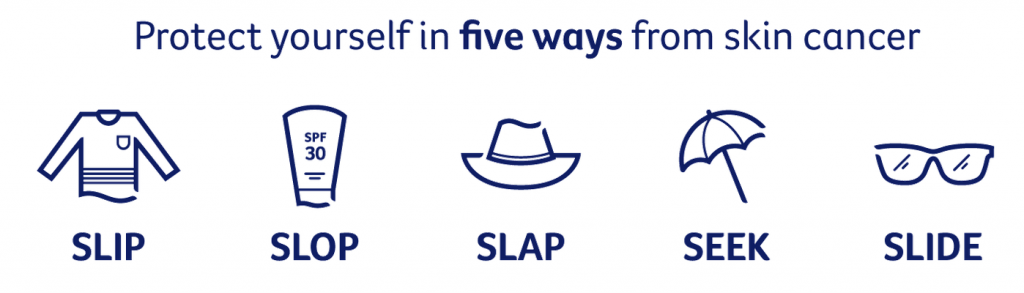
Most education systems, schools and businesses have a sun protection policy to protect children and staff, reducing the risk of developing skin cancers. Australians, possibly more than any other nationalities, understand their risks due to our cruel sun. The “no hat no play” policy in most schools, while great, doesn’t cover off on sunscreen / sunblock. The Cancer Council’s “Slip Slop Slap” campaign launched in 1981 is known to most Australians and helps us explain our diligence to sun protection. Having this extended to its current “Slip slop, slap, seek and slide” wording is even more relevant.
Further information in this section comes under the following headings:
- Why do you need to protect albinism skin?
- Looking after Albinism Skin
- Cover up
- Clothing
- Travelling in the car
- Seek deep shade
- Avoid high UV times
- Skin checks
Why do you need to protect albinism skin?
People with albinism all have changes in genes, resulting in an interruption in the functioning of the enzyme tyrosinase, which synthesizes melanin from the amino acid tyrosine. Depending on exactly which gene is affected, melanin production can either be slowed or completely stopped. Melanin is involved in the development of pigment, which in turn forms a barrier to protect the skin. Those with albinism lack this protection and without it will burn easily, causing long-term damage. (A simple analogy is that the melanin factory is there, it just doesn’t have any workers or working machinery)
Those who have very white hair, including eye lashes and skin (the more common forms of albinism), generally have no melanin and are at extreme risk of sun damage and developing skin cancers over time, including melanoma. They may produce pinkish blemishes or a pink naevus with a smooth raised surface that can develop into a dangerous melanoma. Those who produce small amounts of melanin may have blonde or reddish hair and develop freckles or moles but they also need greater sun protection than normal and have a high skin cancer risk without adequate protection. (See the section below on Skin Checks for information on skin cancers)
- Sun and skin care for people with albinism – notes taken from a talk by NSW dermatologist Dr Monisha Gupta at an AFA gathering in 2013.
Looking after Albinism Skin
Cover up
While a UV level of 3 is seen as a trigger for most people to seek sun protection, those with albinism can burn at lower levels, even on a cloudy day and can suffer burns from rays reflected from objects like sand, buildings, cement, water or snow. It is important to always cover as much skin as possible, with long sleeved clothing. Select a hat with a wide brim or legionnaire style, providing shade for the face, ears and neck. Long pants or dress will provide protection for the legs, and any exposed skin should be covered in sunscreen that provides a barrier for both UVA and UVB rays (broad spectrum).
An easy way to remember the difference: UVA – Ages the skin over time. UVB – Burns the skin. Protect from both!
- About Sunscreen – from the Cancer Council of Australia – check the date, correct storage, how much and how often.
- Sunscreen information from Galderma – an AFA sponosor (and a product recommended by many of our member families).
Clothing
Specialist clothing (designed as SPF) is available on line (check the legitimacy of the site), but choosing a fabric that is closely woven (if you hold the fabric up to the light and you cannot see through it, the sun is less likely to penetrate) will provide greater protection, as will darker colours.
Swimwear is now available for all ages with long legs and sleeves that come down over the back of the hands, but check that it is rated a minimum SPF 30+ – and don’t forget the feet with aqua socks or shoes and an SPF swim hat with brim. In Queensland some of the “stinger suits” will also be suitable and for women, some of the “modest” swim wear provides another option. Fitted “Sleeves” with protection for the arm and hands are also available in most sizes and basic colours to wear with short sleeved clothing. These can be easily removed and are handy to add to regular clothes for the short time you are outside or during breaks and sport at school.
Travelling in the car/plane/train or bus
Travelling in a car provides risks on any sunny day and ensuring the side and rear windows (and any sunroof) have the darkest legal tint (check your state regulations), can provide added protection along with glare reduction. While glass does provide some UVB protection, it does not protect from UVA rays. NDIS may provide funding for window tinting under vehicle modifications. Some cars have pull up screens available (or adding a mesh screen to the window), and wearing sunscreen, hat and wrap around sunglasses give added protection. As windscreens and front windows are generally not allowed darker tints, avoid sitting in the front seat if the sun is streaming in there.
Seek Deep Shade
If you are outside for extended periods on days of high UV radiation, it will also be advisable to seek deep shade, even when wearing protective clothing. Dappled shade from trees or open weave shade sails (allowing some light through) may not be enough, nor will small patches of shade that allow light and rays to be reflected into the area. In deep shade, shadows cannot be cast and there is a considerable reduction in light to the area. Covering prams may create shade, but can cause dangerous over-heating.
Adequate provision of shade outside is particularly important in schools, where most recess and lunch breaks are in the period of highest UV rays, between 10am and 2pm (or 11 and 3 DST). Shade provided in areas like canteens or where students are required to gather for longer periods or lessons, allow for inclusion of students with albinism.
The provision of shade adjacent to PE and Sport areas, allow students with albinism to still participate, while seeking shade in breaks of play, or to dip in and out of games with peers during play times. If a student’s only option is to go indoors, they miss out on physical activity and are also isolated from peers, which is not desirable. Talk to your student’s teachers and school leaders to find a suitable space where they can participate with peers.
- Sun and Glare Protection Statement – an AFA prepared document that may help others to understand your needs.
Avoid High UV times
For adults with albinism or students on a non-school day, planning outdoor activities for morning or evening when UV levels are lower, is the single most important measure for people with albinism to avoid sun damage. Where you can, avoid being in the sun between 10am and 2pm (11am and 3pm DST) when UV levels are the highest. Sunlight is an important source of Vitamin D, but normal incidental exposure to the sun for short periods as we move around, is generally sufficient. Even hanging out the washing or watering the garden should be scheduled in these low UV times as well.
You can check on the daily UV levels through most weather reports, and if you have a smart phone, access the “Sun Smart Global UV” app by Cancer Council Vic (iPhone users can download it at the iTunes App Store and Android users at the Google Play store).
- The Sun, UV and You – a presentation by Dr Anita Lasocki at the 2017 AFA Conference.
- Sun Safety – Cancer Council (Australia).
Skin Checks
It is important to check the skin for any changes on a regular basis. Low vision can make this difficult when examining your own skin, but PWA can do this at home at least twice a year with the help of a parent, partner or good friend. It is important to do this systematically, going over the whole body, checking under the hairline, behind ears, under the feet and between toes, including all areas that are normally not exposed to sun, as cancers can appear anywhere. It can also help to photograph any spots next to a ruler for future reference.
General advice is to look for sores that don’t heal, irregular shaped or multi coloured moles that grow or change, but pale pink or non coloured raised, or conversely sometimes pitted areas, can indicate a problem (pink naevus). Refer to the Cancer Council for more information on what to look for. If anything suspicious is found, see a GP or dermatologist as soon as possible.
It is advisable for all those with albinism to have a regular (at least 2 yearly) check with a dermatologist as some cancers have very little colour. Many practitioners provide a photographic service, giving a baseline reference for future examinations.
 Join us on Facebook